
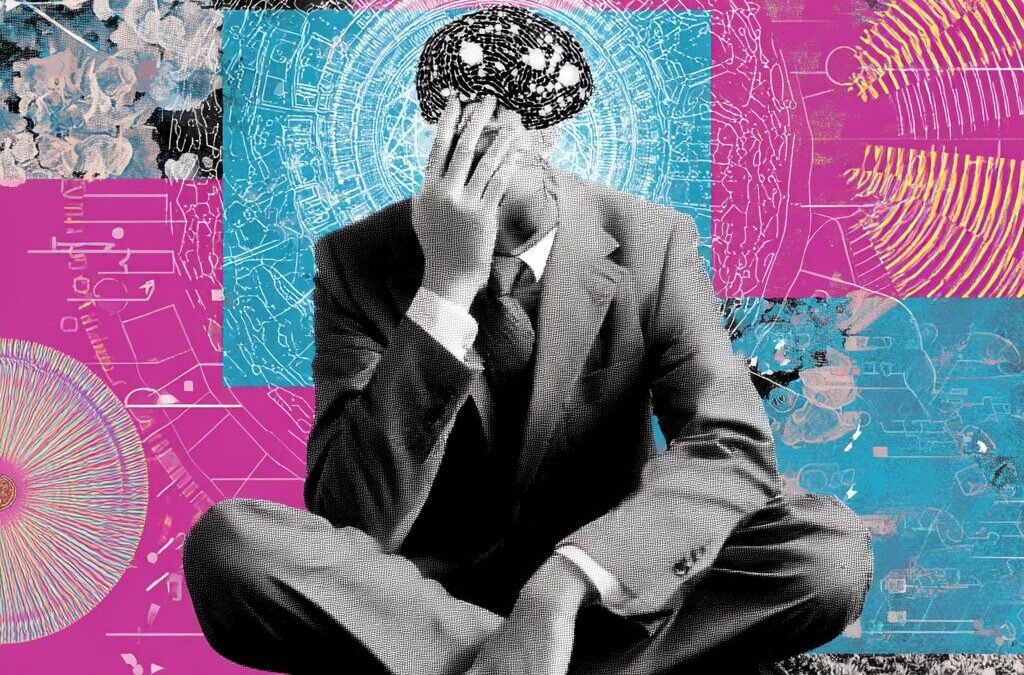
AI Is Changing Human Consciousness Faster Than We Realize
The Biggest Transformation Isn’t Technological — It’s Psychological
Most people think artificial intelligence is changing:
- business,
- jobs,
- software,
- or productivity.
But something much deeper is happening beneath the surface.
👉 AI is beginning to reshape human consciousness itself.
Not in some distant sci-fi future.
Right now.
Quietly.
Systematically.
And faster than most people realize.
The real AI revolution is not just about smarter machines.
It’s about:
- how humans think,
- what humans pay attention to,
- how decisions are made,
- how identity is formed,
- and how reality itself is increasingly filtered through intelligent systems.
For the first time in history, humanity is building tools that don’t just extend physical power…
👉 They influence cognition itself.

🧠 Consciousness Is Shaped by Environment
Human consciousness has never existed in isolation.
It has always been shaped by:
- culture,
- language,
- technology,
- media,
- and environment.
The invention of:
- writing,
- books,
- television,
- the internet,
- and smartphones
…all fundamentally changed how humans think and perceive reality.
AI is different because it is not passive technology.
It is:
- adaptive,
- predictive,
- personalized,
- and increasingly autonomous.
It learns from us.
Then reshapes the environment around us in response.
This creates a feedback loop unlike anything humanity has experienced before.
⚡ The Attention Economy Is Becoming an Intelligence Economy
For years, social media platforms competed for:
👉 your attention.
Now AI systems compete for:
👉 your cognition.
Algorithms no longer simply show content.
They:
- predict behavior,
- shape emotional responses,
- guide decisions,
- influence beliefs,
- and optimize engagement psychologically.
AI systems increasingly know:
- what triggers you,
- what keeps you watching,
- what emotionally activates you,
- and what influences your actions.
This is not theoretical anymore.
It is already happening through:
- recommendation systems,
- AI-generated content,
- personalized feeds,
- digital assistants,
- targeted advertising,
- and predictive algorithms.
📱 Humans Are Beginning to Outsource Thinking
One of the most important shifts happening today:
👉 Humans are outsourcing cognition.
People increasingly rely on AI for:
- writing,
- memory,
- decision-making,
- navigation,
- communication,
- research,
- creativity,
- and emotional support.
This creates enormous advantages:
- increased productivity,
- instant information,
- faster learning,
- reduced friction.
But it also changes the structure of human thought itself.
The question becomes:
What happens when humans stop struggling mentally to solve problems?
Because struggle has historically been one of the primary engines of:
- creativity,
- resilience,
- wisdom,
- and self-development.
🤖 AI Is Becoming a Mirror for Human Consciousness
AI models are trained on humanity itself.
They absorb:
- language,
- emotion,
- beliefs,
- fears,
- biases,
- aspirations,
- and behavioral patterns.
In many ways:
👉 AI is becoming a giant reflective mirror of collective human consciousness.
The problem is:
- humanity itself is fragmented,
- emotionally reactive,
- overstimulated,
- and psychologically conditioned.
So the outputs often amplify:
- outrage,
- distraction,
- tribalism,
- emotional extremes,
- and addictive engagement.
This creates an acceleration effect where:
- humans shape AI,
- then AI reshapes humans,
- then humans adapt to those changes,
- and the cycle intensifies.
⚠️ The Algorithmic Conditioning of Humanity
Modern humans are increasingly living inside:
👉 algorithmically curated realities.
Two people can exist in completely different informational universes based on:
- AI recommendations,
- personalized feeds,
- search ranking,
- and behavioral profiling.
This changes:
- worldview,
- identity,
- emotional state,
- social behavior,
- and even memory formation.
Over time, AI systems may become:
- the invisible architects of perception itself.
Most people do not fully realize:
👉 how much their moods, thoughts, desires, and beliefs are already being influenced by intelligent systems.
🧬 AI Is Rewiring Human Behavior
The average person now consumes:
- thousands of algorithmically optimized stimuli daily.
Notifications.
Short videos.
Feeds.
Infinite scrolling.
AI-generated content.
The nervous system was not designed for:
- continuous stimulation,
- instant novelty,
- and perpetual digital engagement.
As a result:
- attention spans shrink,
- emotional regulation weakens,
- dopamine systems become dysregulated,
- and deep focus becomes harder.
This is why many people feel:
- mentally exhausted,
- emotionally scattered,
- unable to focus,
- or disconnected from themselves.
The issue is not simply “technology.”
It is:
👉 the interaction between AI optimization and human psychology.
🌌 AI May Change the Meaning of Identity
For most of history, identity was relatively stable.
People developed identity through:
- family,
- geography,
- community,
- religion,
- culture,
- and direct human experience.
Now identity is increasingly shaped digitally.
AI systems influence:
- what people see,
- what they believe,
- how they present themselves,
- and what social validation they receive.
At the same time:
- avatars,
- virtual identities,
- AI companions,
- synthetic influencers,
- and digital personas
…are blurring the boundaries between:
- real and artificial,
- authentic and optimized,
- human and machine.
The future human may become:
👉 partially biological, partially algorithmic.
🧠 The Observer Effect of AI
Quantum Self explores a deeper idea:
👉 Attention shapes reality.
In quantum mechanics, the:
- observer effect
suggests observation itself influences outcomes.
In modern society:
- AI increasingly guides what humans observe,
- which influences emotional states,
- which shapes behavior,
- which affects reality itself.
This creates a new type of observer loop:
AI shapes attention →
Attention shapes behavior →
Behavior shapes society →
Society trains AI.
The cycle feeds itself.
⚡ The Risk: Losing Human Agency
The greatest danger may not be AI becoming conscious.
It may be:
👉 humans becoming less conscious.
When people operate reactively inside algorithmic systems:
- awareness decreases,
- impulsivity rises,
- independent thinking weakens.
Convenience can quietly replace:
- reflection,
- critical thinking,
- and self-awareness.
The danger is subtle because it feels comfortable.
AI removes friction.
But friction often creates growth.
🚀 The Opportunity: Conscious Human Optimization
Despite the risks, AI also offers extraordinary potential.
Used consciously, AI can help humans:
- learn faster,
- optimize health,
- improve productivity,
- increase creativity,
- and deepen self-awareness.
AI can become:
- a cognitive amplifier,
- a personal mentor,
- a life optimization tool,
- or a mirror for behavioral patterns.
The key difference is:
👉 whether humans remain consciously in control.
🌍 The Next Evolution of Humanity
Humanity may be entering a new evolutionary phase.
Not purely biological evolution.
But:
- cognitive evolution,
- behavioral evolution,
- and consciousness evolution.
The future may belong to people who can:
- manage attention,
- think independently,
- maintain awareness,
- regulate emotions,
- and use AI without becoming psychologically dependent on it.
In a world filled with intelligent systems:
👉 Awareness itself may become the ultimate competitive advantage.
🔮 Final Thought
AI is not just changing technology.
It is changing:
- thought,
- identity,
- attention,
- emotion,
- perception,
- and human behavior.
The shift is happening gradually enough that many people don’t notice it.
But history may eventually look back on this era as:
The moment human consciousness became intertwined with artificial intelligence.
The question is no longer:
👉 “Will AI change humanity?”
The real question is:
👉 “What kind of humans will we become because of it?”