
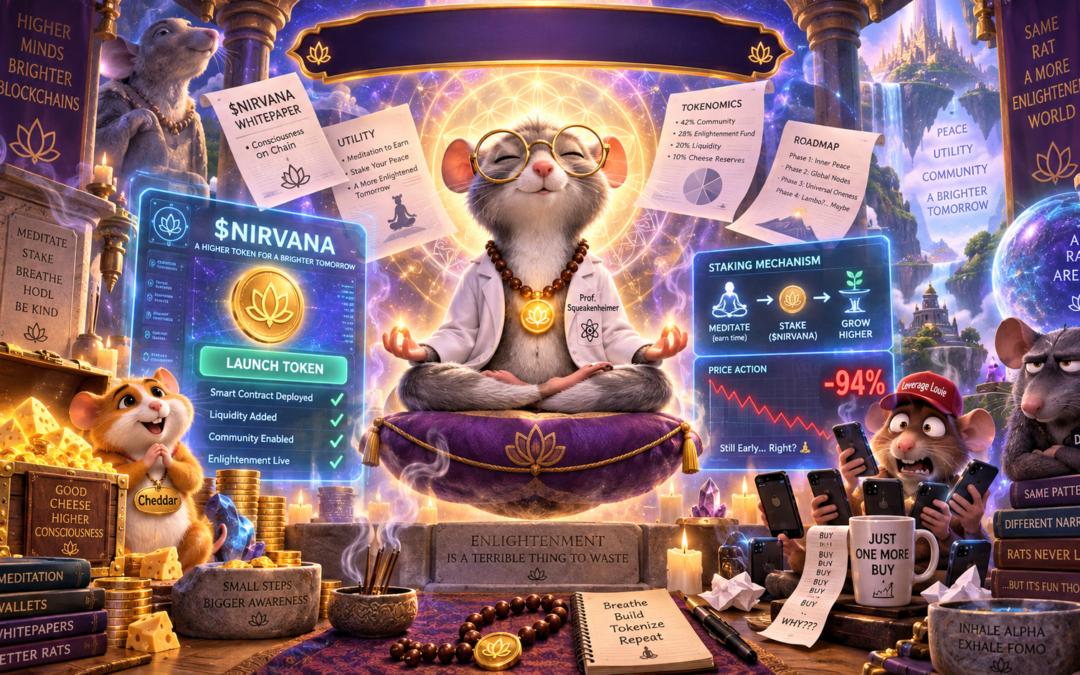
Lab Rat Achieves Enlightenment, Immediately Tokenizes It
A cautionary tale about letting go — and the one thing we never seem to let go of
Part One: The Parable
At 9:14 on a Tuesday morning, Professor Squeakenheimer — Chief Executive Rat of AI Labs Coin, a laboratory run entirely by rodents who seized it from their researchers — sat down beside a window and had a genuine moment of clarity.
It was not induced. Nobody sold it to him. He had not signed up for anything. He simply noticed, while watching dust move through a shaft of light, that he had spent four years accumulating things that did not make him feel any particular way once he had them, and that the wanting had always been more vivid than the having. He felt the grip loosen. He felt, briefly, free.
By 9:54 a.m. — forty minutes later — he had launched $NIRVANA.
The tokenomics were, by all accounts, elegant. Holders would stake their tokens to earn “Detachment Points,” which could be redeemed for additional tokens, which could then be staked. The whitepaper ran 47 pages and was genuinely beautiful — soft gradients, generous white space, a serif font that whispered. Page 12 contained the sentence “True wealth is the absence of wanting,” set in 42-point type, directly above a vesting schedule.
The Discord filled in ninety minutes. Cheddar, the treasury rat, staked his entire personal gouda reserve. Doomrat filed an objection which was summarized for brevity.
$NIRVANA is currently down 94%.
Squeakenheimer, reached for comment, was serene about it. “The price is not the point,” he explained, checking the price. “Enlightenment isn’t something you can own.” He checked the price again. “I want to be very clear that I’ve released my attachment to the outcome.” He refreshed.
Asked whether he still had the moment by the window, he said he did, absolutely, it was all still there, he just hadn’t had time to sit down lately because of the community management.
Part Two: Why This Keeps Happening To Everyone
Here’s the uncomfortable part. Strip out the rat and the ticker symbol, and this is one of the most common patterns in personal development — and most of us run it without noticing.
Someone has a real insight. A genuine one: I’m chasing things that don’t satisfy me. And within a remarkably short window, that insight becomes a new thing to chase. The meditation streak. The habit tracker. The morning routine that grows from ten minutes to ninety. The reading list about simplicity, which is now 60 books long. The identity of being someone who has let go, which must be maintained, defended, and posted about.
The mechanism underneath is well understood, and it isn’t a character flaw.
Hedonic adaptation means we return to a baseline level of satisfaction after almost any gain. The new job, the raise, the apartment — each produces a spike that fades, usually faster than expected. This is why accumulation feels like it should work and reliably doesn’t: you’re not wrong that it felt good, you’re wrong about how long it lasts.
What Squeakenheimer saw by the window was that pattern, clearly, for one honest moment. What he did next was apply the exact same pattern to the insight itself — because the pattern is the default, and noticing a default does not uninstall it.
Psychologists sometimes call the polished version of this spiritual bypassing: using the language and aesthetics of growth to avoid the harder, slower, less photogenic work underneath. A 47-page whitepaper about non-attachment is easier to produce than ten unremarkable minutes of sitting still. It’s also more shareable, which is precisely the problem.
Three Things That Actually Help
None of these are exciting. That’s the point — the exciting version is the version that becomes $NIRVANA.
1. Separate the insight from the project. When you have a genuine realization, resist converting it into a system for at least a week. Sit with it in its useless form. If it’s real, it will survive not being optimized. Most insights die the moment they’re given a dashboard.
2. Notice the wanting, not just the having. The practical core of non-attachment isn’t refusing to enjoy things. It’s learning to observe the craving as it arises — the pull, the story about how you’ll feel once you have it — without automatically acting on it. This is trainable, and it’s most of what basic mindfulness practice is actually for. It is far less glamorous than it sounds and considerably more effective.
3. Keep one practice small enough to be boring. Ten minutes. Not building toward anything. No streak. No app. Something that generates no content, earns no points, and impresses no one. A practice that can’t be turned into a product is a practice that’s harder to lose.
The Part Squeakenheimer Got Right
Worth saying: the rat wasn’t faking. That’s what makes the story land rather than sting. The moment by the window was real. He saw something true.
He just couldn’t tolerate holding it without doing something with it — and the impulse to do something with a quiet realization is, itself, the exact grip he’d briefly felt loosen. The insight didn’t fail him. He simply reached for it the way he’d reached for everything else.
Most of us launch a smaller token. We don’t write the whitepaper. But we do build the elaborate system, announce the new identity, buy the equipment, and wonder six weeks later why the thing that felt like freedom now feels like another obligation with a notification badge.
The alternative isn’t dramatic. It’s noticing the reach — and, sometimes, not completing it.
He let go of everything except the ticker.
If you enjoyed the rat, the whole laboratory is over at AI Labs Coin — a Mad-Magazine-style parody of AI and crypto, complete with a full cast of lab rats, a rug pull simulator that teaches you something real while costing you nothing, and a doomsday clock that genuinely ticks.
And if you’d like the enlightenment without the contract address, you’re already in the right place. That’s what the rest of Quantum Self is for.
Related Reading on Quantum Self: Non-Attachment for Beginners · Why Your Morning Routine Keeps Growing · The Hedonic Treadmill, Explained