Your Brain Is Software: Here’s How AI Could Rewrite Your Life
The Most Advanced Technology in the Universe
The most powerful computer ever created is not sitting in a data center.
It is not inside a quantum laboratory.
It is not being developed by a technology company.
It is inside your skull.
The human brain contains roughly 86 billion neurons and trillions of neural connections. It continuously processes information, predicts outcomes, stores memories, creates emotions, forms beliefs, and generates the experience we call reality.
Yet most people operate this extraordinary system with very little understanding of how it actually works.
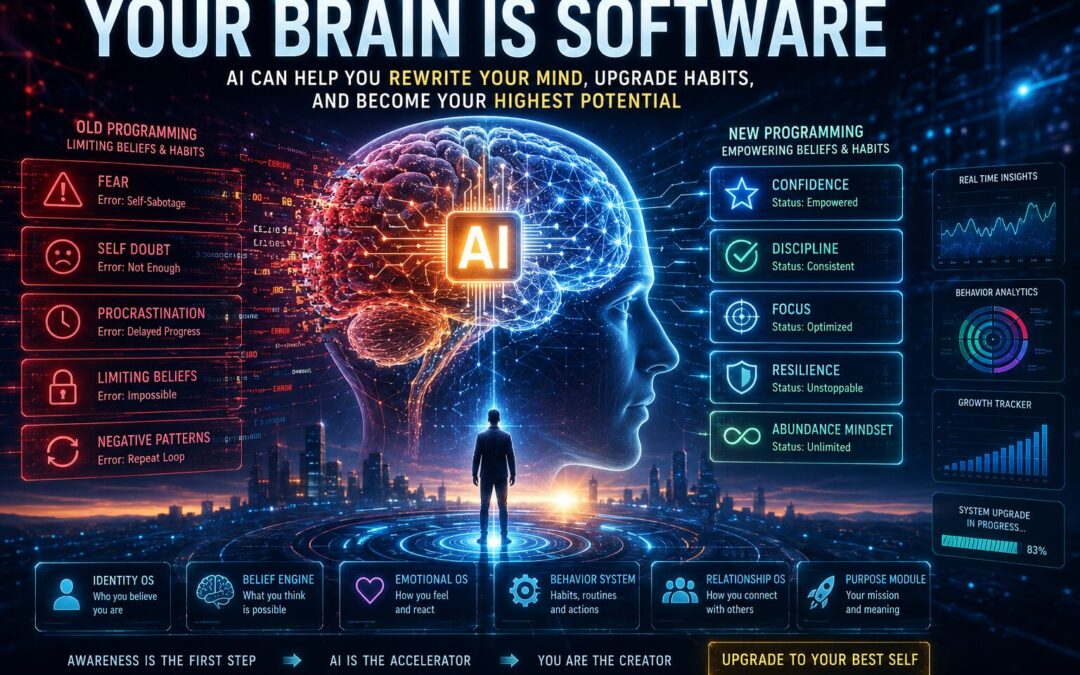
What if the brain is less like a machine and more like software?
And what if artificial intelligence could help us understand, debug, optimize, and even rewrite that software?
This possibility may become one of the most important developments of the 21st century.
The Programs Running Your Life
Most people believe they consciously control their decisions.
Psychology suggests otherwise.
Researchers estimate that much of our daily behavior is driven by subconscious patterns and habits.
These patterns act much like software running in the background.
Examples include:
- Fear of failure
- Imposter syndrome
- Procrastination
- Anxiety
- Self-doubt
- Relationship patterns
- Financial habits
- Health behaviors
Many of these programs were installed long before we were aware they existed.
Parents.
Teachers.
Culture.
Media.
Traumatic experiences.
Childhood beliefs.
Over time these patterns become automatic.
You may think:
“I am not good at business.”
“I always attract the wrong people.”
“I can never stay disciplined.”
“I am bad with money.”
But what if these are not truths?
What if they are simply lines of code running in your mental operating system?
The Human Operating System
Imagine your mind as software composed of multiple modules.
Identity Module
Answers:
- Who am I?
- What kind of person am I?
Belief Module
Answers:
- What is possible?
- What is impossible?
Emotional Module
Controls:
- Fear
- Confidence
- Happiness
- Anxiety
Behavioral Module
Determines:
- Habits
- Routines
- Reactions
Social Module
Influences:
- Relationships
- Communication
- Belonging
Together these modules create the experience of being you.
Most people never inspect the code.
They simply run it.
The Discovery of Mental Bugs
Every software system develops bugs.
Humans are no different.
Cognitive science has identified hundreds of biases and mental distortions.
Examples include:
Confirmation Bias
Seeking information that confirms existing beliefs.
Negativity Bias
Paying more attention to threats than opportunities.
Availability Bias
Overestimating events that are emotionally memorable.
Status Quo Bias
Resisting beneficial change.
These bugs influence decisions every day.
Often without our awareness.
The challenge is that humans struggle to see their own blind spots.
This is where AI becomes interesting.
AI as a Cognitive Mirror
Artificial intelligence may become the most powerful self-awareness tool ever created.
Imagine an AI that continuously observes:
- Your habits
- Your decisions
- Your communication patterns
- Your emotional responses
- Your goals
Over time it begins identifying recurring patterns.
Perhaps it notices:
“You avoid opportunities whenever uncertainty exceeds 20%.”
Or:
“You become less productive after negative social interactions.”
Or:
“You consistently underestimate your abilities.”
Unlike friends, family, or coworkers, AI can analyze millions of data points objectively.
It becomes a mirror reflecting patterns that are difficult for us to see ourselves.
Prompt Engineering for Humans
Today people learn how to prompt AI systems.
Tomorrow we may learn how to prompt ourselves.
Prompt engineering is essentially the art of asking better questions.
The same principle applies to the mind.
Instead of asking:
“Why does this always happen to me?”
You ask:
“What can I learn from this situation?”
Instead of:
“What if I fail?”
You ask:
“What if I succeed?”
Small changes in questions often create large changes in behavior.
Future AI systems may help generate better prompts for our minds.
In effect, AI becomes a cognitive coach.
Rewriting Habits
Habits are among the most powerful forms of mental software.
Many people assume habits are expressions of willpower.
In reality, habits are often automated loops.
Cue.
Behavior.
Reward.
Repeat.
AI systems are increasingly capable of tracking these loops.
Imagine receiving daily feedback such as:
“You are most likely to skip exercise after poor sleep.”
Or:
“Your highest productivity occurs between 8:00 and 10:00 AM.”
By identifying patterns invisible to conscious awareness, AI could help people redesign their routines with unprecedented precision.
Reprogramming Identity
The most transformative possibility may not involve habits.
It may involve identity itself.
Many people define themselves through narratives.
Stories such as:
“I am shy.”
“I am unlucky.”
“I am not creative.”
“I am too old.”
These stories become self-fulfilling prophecies.
The brain seeks evidence supporting the identity it believes to be true.
AI could eventually identify limiting identities and challenge them.
Not through motivation.
Through evidence.
Showing users how their actual behavior differs from the story they tell themselves.
The result may be a profound shift in self-perception.
The Rise of the Personal AI Coach
Imagine a future where everyone has an AI companion trained specifically on their life.
It knows:
- Your goals
- Your strengths
- Your weaknesses
- Your habits
- Your values
- Your history
It becomes:
- Therapist
- Coach
- Mentor
- Strategist
- Accountability partner
Available 24 hours a day.
Unlike generic advice, recommendations become highly personalized.
Your growth becomes data-driven.
The Quantum Self
The most fascinating possibility is that human beings are not fixed entities.
They are evolving systems.
Every belief can be questioned.
Every habit can be modified.
Every behavior can be improved.
Every identity can evolve.
Quantum psychology suggests that many of the limitations people experience are not objective realities but conditioned perceptions.
We often mistake our current version of ourselves for our permanent self.
Yet human beings are remarkably adaptable.
AI may accelerate that adaptability.
Helping individuals move from unconscious programming to conscious design.
The Great Human Upgrade
The future of AI may not be about replacing humans.
It may be about helping humans upgrade themselves.
The greatest opportunity of the AI age may not be building smarter machines.
It may be helping people become smarter, healthier, happier, more aware, and more intentional.
For thousands of years humanity has attempted to understand itself through philosophy, religion, psychology, and science.
Now a new tool has arrived.
A tool capable of revealing patterns hidden beneath conscious awareness.
A tool that may help us identify our mental bugs, rewrite our habits, challenge our assumptions, and unlock greater human potential.
The question is no longer whether technology can change our lives.
It already has.
The real question is:
If your brain is software, what version of yourself do you want to run?
Would You Rather…
🧠 Keep the personality, habits, and beliefs you have today forever…
OR
🚀 Be able to completely rewrite your mind and become anyone you choose?
Your answer may reveal more about you than you think.