
Evidence: Emerging Research / Future Scenario · 13 min read · Intermediate
For decades, brain-computer interfaces (BCIs) lived in science fiction. Now people with paralysis have used them to move cursors, type sentences, and guide robotic arms with their thoughts — and companies with billion-dollar valuations are racing toward wider medical use.
It is one of the most exciting technologies of the century, and one of the most ethically loaded. A device that reads your brain touches the last truly private space you own: the inside of your head. This guide separates what's real from what's coming from what's still hype, then turns to the questions we should be answering before the technology scales — about privacy, identity, and who gets to be part of this future.
What Is a Brain-Computer Interface?
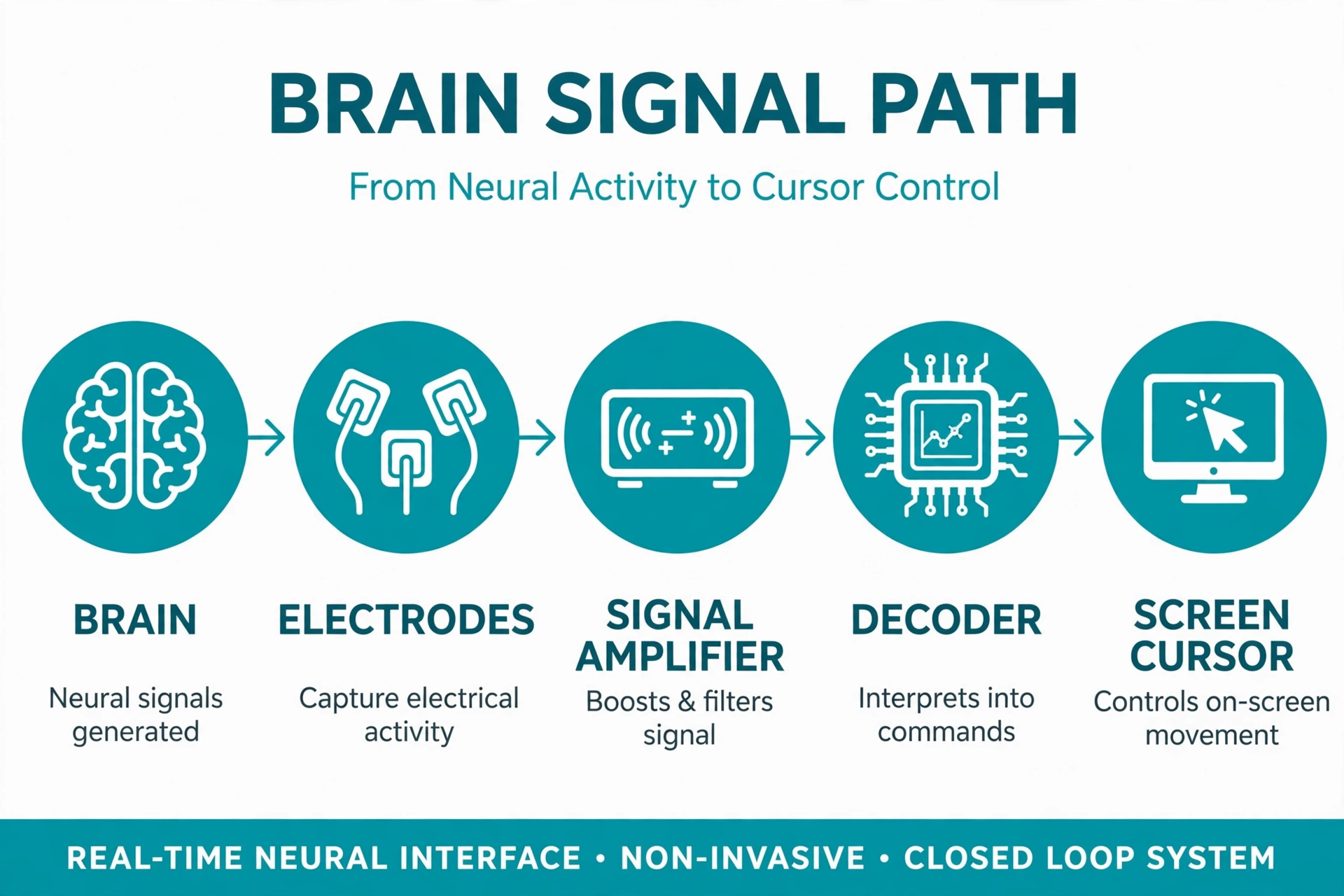
A brain-computer interface is a system that reads signals from the brain, interprets them, and uses them to control an external device — or, in some designs, sends signals back into the brain. The basic pipeline looks like this:
- Sense neural activity — electrical signals from neurons, picked up by electrodes.
- Decode the signals with algorithms, increasingly machine learning models trained on the individual user's brain.
- Act — move a cursor, produce text or speech, drive a robotic limb.
- Feedback — the user sees or feels the result, and the brain and the system learn together. This co-adaptation is part of why BCIs improve with practice: the user's brain literally reorganizes around the interface.
Most BCIs today are open-loop (brain to device, one direction). The frontier is closed-loop systems that also stimulate the brain in response — for example, restoring a sense of touch to a prosthetic hand, or adjusting deep-brain stimulation in real time based on detected brain states. Bidirectional interfaces are where the medicine gets most powerful — and where the ethical questions get most interesting.
Three Main Types
| Type | How it works | Strengths | Limits |
|---|---|---|---|
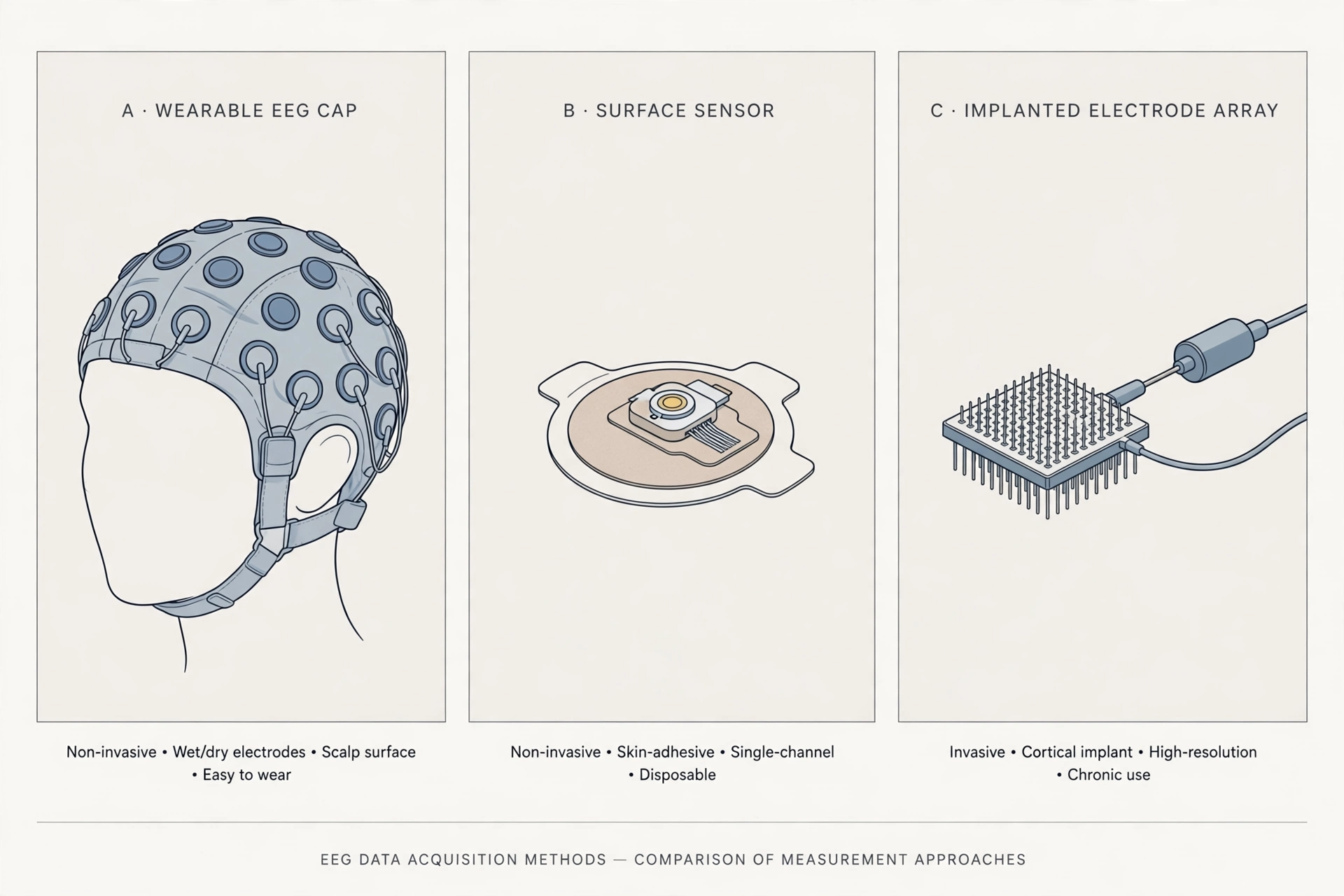
| Non-invasive (e.g., EEG headsets) | Sensors on the scalp pick up electrical activity through the skull | Safe, cheap, no surgery; great for research and wellness gadgets | Noisy signal, low resolution — the skull smears everything |
| Partially invasive (e.g., sensors on the brain surface) | Electrodes placed under the skull, resting on the brain's surface (ECoG) | Much cleaner signal than scalp; less invasive than penetrating electrodes | Still requires surgery |
| Invasive (e.g., implanted electrode arrays) | Electrodes inserted into brain tissue itself | Highest precision — can resolve the firing of individual neurons | Surgical risk, infection risk, long-term durability questions |
Each rung up the invasiveness ladder buys signal quality at the price of risk. That trade-off shapes the entire field: the most capable systems are surgical, and the safest ones are blunt instruments. The race right now is to push capability down the invasiveness ladder — and to make the invasive options safer and longer-lasting.
What BCIs Can Actually Do Today
Strip away the press releases and this is the verified record from clinical research and trials:
- Communication for people who cannot speak or move. In landmark studies, participants with paralysis have produced text by imagining handwriting — with decoding speeds reported around 60+ words per minute in some trials, approaching natural conversation pace. Other work has decoded attempted speech directly from brain activity into text or synthesized voice.
- Control of cursors and robotic arms. People with tetraplegia have used implanted BCIs to move computer cursors, type, browse, and guide robotic arms to grasp objects — in some cases, with enough reliability to use in daily life during trials.
- Restoring movement around spinal injuries. Early studies have bridged signals around spinal cord injuries — reading motor intent from the brain and stimulating muscles or the spinal cord below the injury to produce movement.
- Therapeutic stimulation. Deep brain stimulation (DBS) for Parkinson's disease and other movement disorders is an established, FDA-approved clinical neurotechnology — a reminder that "technology in the brain" is not new; what is new is the two-way, high-bandwidth conversation.
- Less-invasive approaches advancing. Companies are pursuing middle paths: stent-like electrodes delivered through blood vessels (avoiding open-brain surgery), and ultra-thin surface arrays designed to be less damaging than rigid implants.
The key players to know: academic programs like BrainGate (running human trials for nearly two decades), and companies including Neuralink (implanted arrays, human trials underway), Synchron (stentrode delivered via blood vessels), Paradromics, and Precision Neuroscience (surface arrays). Their approaches differ, but they're all converging on the same near-term goal: reliable, medical-grade neural interfaces for people with severe paralysis and neurological conditions.
The honest caveats: these results come from small studies, often with carefully supported participants, and long-term reliability — years of stable performance, device durability, software support — is still being evaluated. A BCI that works brilliantly in month three and degrades by month thirty is a very different technology than the headlines suggest.
Where the Hype Runs Ahead of Reality
- "Mind reading." Current BCIs decode narrow, trained signals — intended movement, attempted speech. They do not read arbitrary private thoughts, memories, or beliefs. The gap between "we decoded which letter you imagined writing" and "we know what you're thinking" is enormous, and honest researchers say so.
- "Download your brain" / "merge with AI." No existing technology comes close, and the scientific path is unclear. The brain is not a hard drive; "uploading consciousness" remains philosophy, not engineering.
- Consumer "brain-boosting" headsets. Many make performance and wellness claims that outpace the evidence. EEG headbands can measure something, but the leap from signal to "improved focus" is mostly marketing.
- Timelines. Product announcements routinely promise faster progress than regulated clinical development delivers. Brain implants go through years of trials, safety review, and long-term follow-up. The technology moves fast; the medicine moves carefully — and it should.
- "It worked in the demo." A controlled lab result with a hand-picked participant and a team of engineers on standby is not the same as a device someone lives with. Ask about reliability, independence, and years — not just the peak demo moment.
The Hope
If the technology matures, the potential benefits are profound — and for the people who need them, they are not abstractions:
- Restoring communication for people with ALS, stroke, or locked-in syndrome — giving voice back to people who have lost it.
- Restoring mobility and independence after spinal cord injury — not just movement, but the dignity of doing for oneself.
- Treating conditions like epilepsy, depression, or chronic pain with precise, adaptive neurostimulation instead of blunt pharmaceuticals.
- New windows into the brain itself — BCIs are also research instruments, and every clinical system teaches us more about how neural circuits produce thought, intention, and experience.
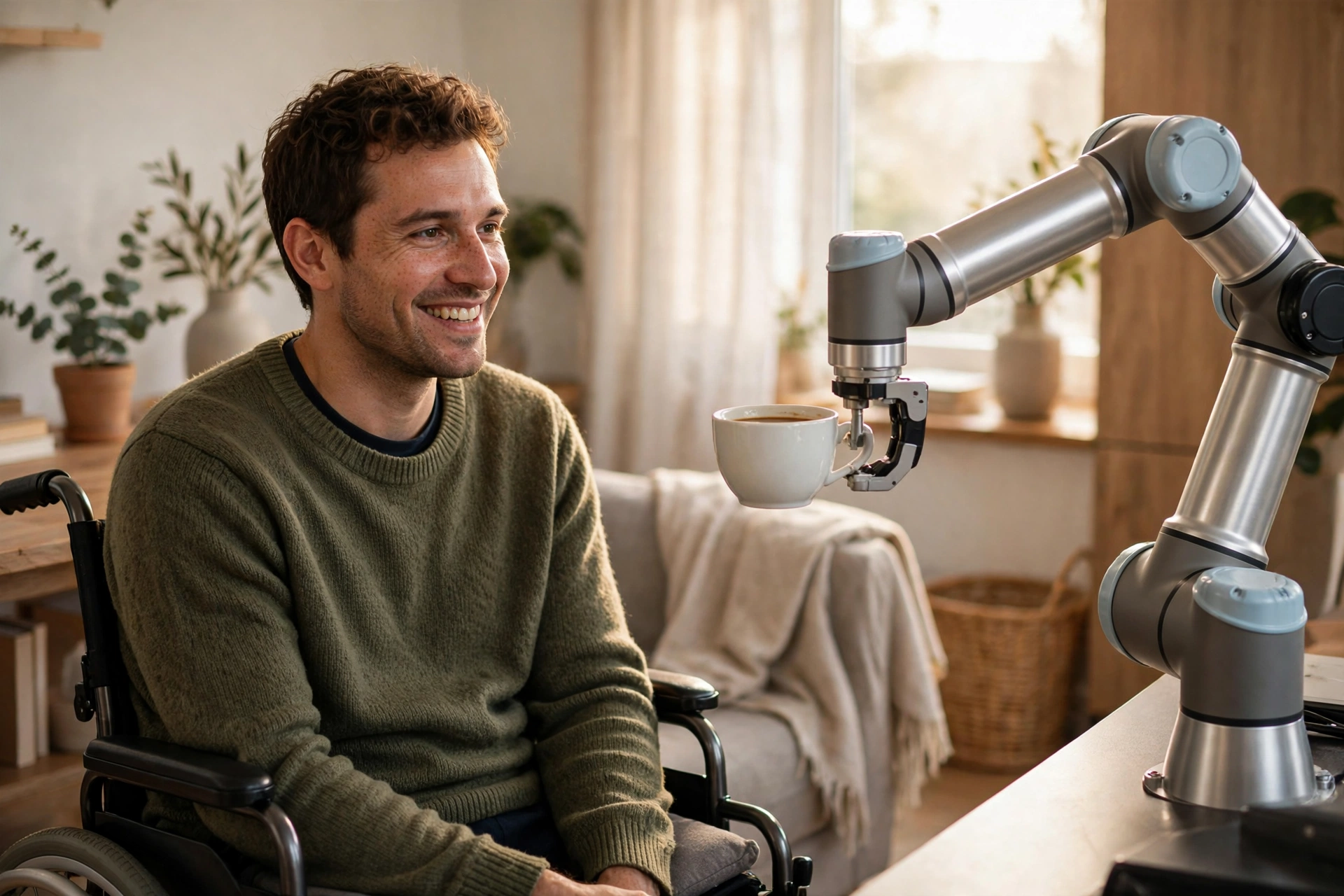
Talk to the families in these trials and the word that comes up is agency. The technology's deepest promise isn't superhuman ability — it's the return of ordinary human autonomy: typing a message, lifting a cup, saying "I love you" without an intermediary. Hold onto that image when the ethics get heavy, because it's the reason the work matters.
The Ethics Nobody Is Talking About Enough
1. Neural privacy — your last private room
Brain data could reveal attention, emotion, cognitive load, health status, and possibly preferences and predispositions. Who owns that data? Can it be sold, subpoenaed, used for advertising, hiring, or insurance? Existing privacy laws were not designed for neural data — though the gap is starting to close: Chile amended its constitution in 2021 to protect neurorights, the first country to do so, and several U.S. states have begun adding neural-data protections to privacy law. The Neurorights Foundation and others are pushing for mental privacy to be recognized as a fundamental right. But the default, right now, in most places, is unprotected — and commercial incentives point toward collecting as much as possible.
2. Consent and abandonment
Users of implanted devices may depend on a company's software for years. What happens if the company folds, stops supporting the device, or changes the terms? This is not hypothetical: patients with retinal implants from the company Second Sight were left with unsupported devices in their eyes when the company pivoted — a warning the BCI field has heard loud and clear. An implant is not a phone; you cannot just switch brands. Long-term support commitments need to be part of the deal from day one.
3. Identity and agency
If an algorithm helps decide what you intend, whose action is it? When stimulation alters mood or impulse, where does the device end and the person begin? Researchers are actively studying how neurostimulation and decoding change people's sense of self — and early reports suggest the effects are real and sometimes unsettling. This is philosophy with a circuit board attached: the technology forces us to operationalize questions about free will that used to be dorm-room debates.
4. Security — "brainjacking" isn't just a scary word
Any connected device can be hacked. For a brain interface, the stakes include safety (malicious stimulation), privacy (exfiltrated neural data), and in the worst theoretical cases, manipulation. Security researchers have already demonstrated proof-of-concept attacks on neural devices in lab settings. The field needs the security culture of aviation or medical devices, not the "move fast" culture of consumer tech.
5. Equity and access
Early BCIs will be expensive — surgery, hardware, years of support. Will they widen the gap between those who can afford cognitive and physical restoration and those who cannot? And as the technology drifts from therapy toward enhancement, the divide could become a chasm: those with augmented memory, attention, or processing against those without. The disability community has a sharp and necessary voice here: restoration is a right; enhancement is a market — and the line between them will be drawn by whoever can afford to draw it, unless we decide otherwise deliberately.
6. Enhancement vs. therapy
Restoring lost function is widely accepted. Enhancing healthy people raises harder questions: fairness, social pressure ("everyone at the firm has the focus implant"), coercion, and what counts as "normal." We have been here before with other technologies — and we rarely answered the questions before the market did.
7. Regulation and oversight
Clinical-trial transparency, long-term follow-up registries, and clear rules for neural data are still developing. The technology is advancing faster than the governance — a familiar pattern, but a dangerous one when the substrate is the human brain.
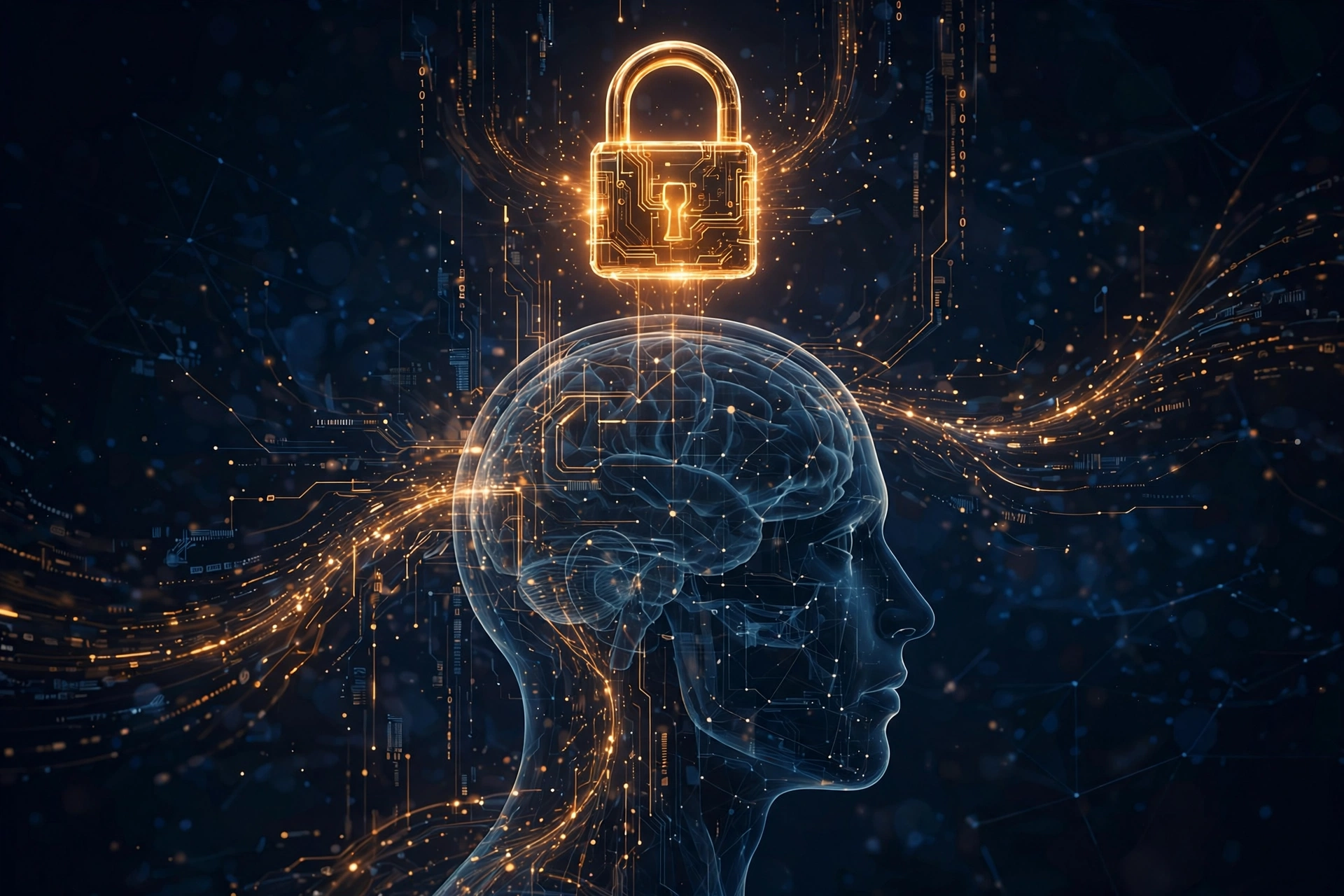
The Deeper Question: What Does a BCI Mean for the Self?
Quantum Self readers will recognize the thread running underneath all of this: the brain is not just an organ we interface with — it's the seat of the observer, the "I" that experiences everything. A technology that reads from and writes to that seat doesn't just change medicine; it changes the relationship between consciousness and the world.
Consider the extended-mind idea: we already treat smartphones as part of our cognitive apparatus — memory, navigation, calculation outsourced to glass rectangles. A BCI collapses the distance further. When thought becomes action without the body as intermediary, the boundary between intending and doing thins. When a device helps complete your sentences, the boundary between your thought and the system's prediction blurs.
This is not a reason to fear the technology. It is a reason to stay conscious about it — to insist that as our tools merge more deeply with our minds, we keep asking who is steering. The observer effect, in the end, may apply here too: the way we choose to relate to these interfaces will shape what they become. A culture that treats neural technology as a product to be optimized will get products. A culture that treats it as an extension of the self to be honored might get something wiser.
Stay hopeful about what BCIs can restore. Stay skeptical about what they're claimed to do. And stay in the conversation — because the decisions being made now, in labs and boardrooms and legislatures, will define the terms on which human minds meet machines for the rest of the century.
What Responsible Progress Looks Like
- Strong, specific protections for neural data — with meaningful consent, purpose limitation, and hard limits on commercial use. Mental privacy as a right, not a setting.
- Open reporting of trial results, including failures, adverse events, and long-term degradation — not just the highlight reels.
- Long-term device support commitments — legal and financial structures so patients are never abandoned when a company pivots.
- Inclusive design that puts disabled communities at the table when priorities are set — "nothing about us without us" applies to neurotechnology too.
- Security treated as safety-critical from the first prototype, not bolted on after the first breach.
- Public conversation before, not after, the technology scales — ethics as infrastructure, not PR.
How to Read BCI News Critically
- Is it a peer-reviewed study or a company announcement? (They are different genres.)
- How many participants, and for how long? One person for a month is a demo; dozens for years is evidence.
- Is the result in a lab or in daily life? Independence matters more than peak performance.
- What does "works" mean — accuracy, speed, reliability, durability? Ask for all four.
- Who funds it, and what are they selling? Follow the incentive the way you'd follow the money in any other story.
The Takeaway
Brain-computer interfaces are real, advancing, and deeply promising for medicine. They are not yet mind-reading or mind-merging machines — and the hardest questions aren't technical but human: who owns your neural data, who gets access, and who decides.
The technology will keep moving. The question is whether our wisdom moves with it.
Educational content only. Not medical advice. Clinical results cited are from early-stage research; check recent peer-reviewed sources for the latest.
Sources: BrainGate clinical trial program (public trial data); Stanford/Howard Hughes Medical Institute handwriting-decoding studies; UCSF speech neuroprosthesis research; company trial disclosures from Neuralink, Synchron, Paradromics, Precision Neuroscience; Chile Law 21.383 / constitutional neurorights reform (2021); Neurorights Foundation; Second Sight / Argus II patient-support reporting; foundational BCI security literature; WHO/UNESCO neurotechnology ethics discussions.
Related on Quantum Self: The Future of Brain-Machine Interfaces: Merging Human Intelligence with AI through Neuralink