
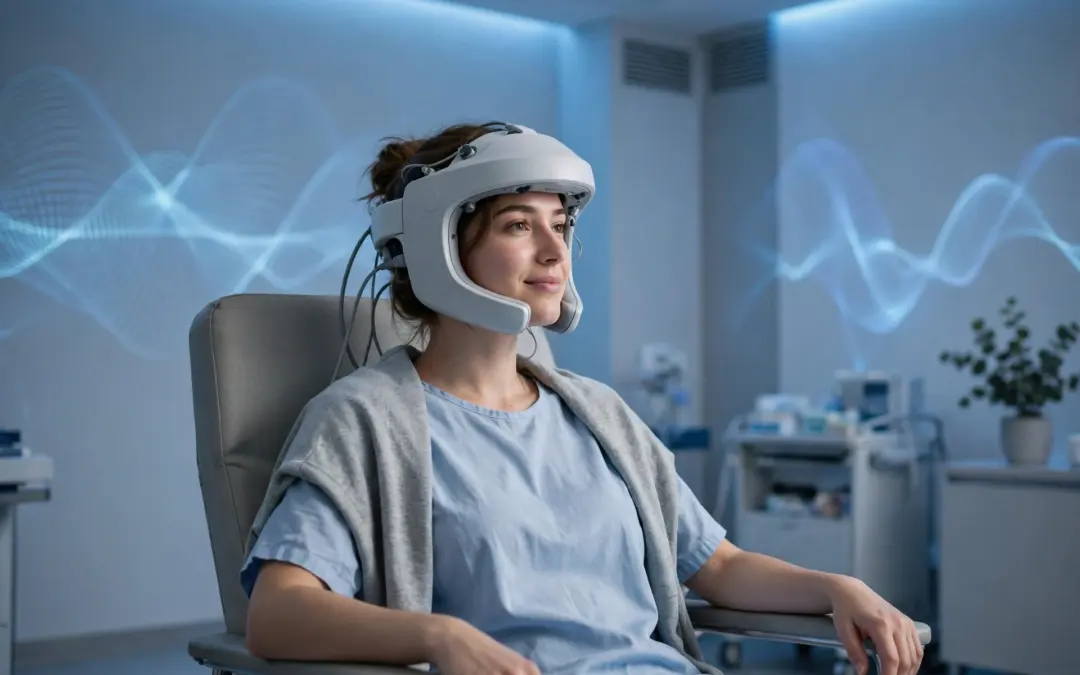
Quantum computing gets the keynote speeches, the magazine covers, and the breathless predictions. But while the world waits for a quantum computer that can outperform a laptop without a room full of cryogenic plumbing, another branch of quantum technology has quietly gone to work. It is sitting in hospital imaging suites, riding in survey trucks, and ticking inside the infrastructure you used to read this page. Nobody photographed its arrival, because it doesn’t look like the future. It looks like a helmet, a box, and a very, very good clock.
These are quantum sensors — devices that exploit superposition, entanglement, and the discrete energy levels of atoms to measure things classical instruments physically cannot. And unlike quantum computers, they are not waiting on a breakthrough. They are deployed.
A Brain Scanner You Can Wear
The clearest example sits on a patient’s head. Magnetoencephalography (MEG) maps brain activity by detecting the magnetic fields your neurons produce — fields roughly a billion times weaker than the Earth’s. For decades, MEG required superconducting sensors bathed in liquid helium, which meant the patient had to sit perfectly still inside a rigid, one-size-fits-all helmet cooled to near absolute zero. Children, people with epilepsy, and anyone who couldn’t hold still were hard to scan, and the machines were expensive enough that most hospitals never had one.
Optically pumped magnetometers (OPMs) changed the physics of the room. These quantum sensors use laser light to prepare atoms in a vapor cell so their spins respond to magnetic fields — no cryogenics, no superconducting coils. Because they work at room temperature, they can sit millimeters from the scalp inside a lightweight, wearable helmet. The patient can move. A child can sit on a parent’s lap. Researchers have used wearable MEG systems to study epilepsy, dementia, and brain development in ways the frozen old machines simply couldn’t attempt.
The clinical implications are concrete:
- Epilepsy localization — pinpointing where seizures originate so surgeons know what to remove and what to leave alone
- Earlier dementia research — tracking subtle changes in brain rhythms over repeated, comfortable scans
- Pediatric imaging — scanning children without sedation or a frightening, immobile machine
- Heart imaging — magnetocardiography using the same class of sensor to map the heart’s magnetic field without electrodes
The quantum revolution didn’t arrive with a press conference. It arrived as a helmet a child could wear.
Gravity, Clocks, and the Rest of the Deployed Fleet
Hospitals are the headline, but the fleet is wider. Quantum gravimeters — which drop clouds of ultra-cold atoms and read the interference pattern as they fall — can detect tiny variations in local gravity. Survey teams have field-tested them to find buried tunnels, pipes, and voids before construction crews dig, and to monitor water tables and volcanic systems. An instrument that can “see” underground without drilling is not a lab curiosity; it is a tool civil engineers have wanted for a century.
Then there are atomic clocks, the oldest quantum sensors of all and the most invisible. The Global Positioning System is, at its core, a constellation of atomic clocks whose timing signals your phone triangulates. Power grids use precise timing to balance load. Financial networks timestamp trades with it. Telecommunications networks synchronize with it. The metrologists at agencies like the U.S. National Institute of Standards and Technology keep pushing clock precision toward levels where a clock would lose less than a second over the age of the universe — and each improvement propagates quietly into navigation, science, and infrastructure.
Add to the list diamond-based magnetometers built around nitrogen-vacancy centers, which can map magnetic fields at the scale of individual cells, and quantum-enhanced microscopes and gyroscopes in active development. The pattern is the same everywhere: measure something exquisitely small, exquisitely well.
Why Sensors Shipped First
It is worth asking why sensors beat computers to the real world, because the answer explains the whole quantum landscape. A quantum computer must keep hundreds or thousands of qubits coherent, correct their errors faster than they accumulate, and do it all while performing operations on them — an error-correction wall the field is still climbing. A quantum sensor asks far less of nature. It needs one well-controlled quantum system, prepared carefully, allowed to interact with the thing being measured, and then read out. The fragility that plagues quantum computing is, in sensing, the entire point: a system that responds to the faintest magnetic field or the slightest tug of gravity is fragile in exactly the way a good instrument should be.
Richard Feynman, who helped invent the modern picture of quantum mechanics, was characteristically honest about its strangeness:
“I think I can safely say that nobody understands quantum mechanics.” — Richard Feynman
The sensors are a useful reply to that humility. We may not fully understand quantum mechanics, but we understand it well enough to build instruments that outperform every classical alternative — and those instruments are already earning their keep.
Insights: What the Quiet Revolution Tells Us
- Deployment beats demonstration. The quantum technologies changing lives today are the unglamorous ones solving specific measurement problems, not the ones chasing supremacy headlines.
- Sensitivity is the product. Every successful quantum sensor sells the same thing — the ability to detect a signal that was previously buried in noise, whether that’s a neuron firing or a void under a road.
- The cost curve is the story to watch. As OPMs and chip-scale atomic clocks shrink and cheapen, expect quantum sensing to spread from specialist centers into ordinary hospitals, clinics, and field kits.
- Hospitals are the beachhead, not the boundary. Medicine adopted quantum sensing early because the payoff — seeing the living brain in action — was worth it. Other industries are following the same logic.
A Note on Consciousness, Kept Honest
A site called Quantum Self cannot end an article about measuring the brain without addressing the obvious question: does any of this tell us whether consciousness itself is quantum? The honest answer is no — not yet, and maybe not ever. Wearable MEG gives us better maps of the brain’s magnetic activity, and better maps will sharpen the questions neuroscience can ask. But a better map of neural activity is not evidence that the mind runs on quantum computation, and the leading proposals that it might remain speculative and contested. What the sensors genuinely offer the consciousness debate is humility plus data: the ability to watch a living, moving, thinking brain with unprecedented fidelity, and to let the evidence — not the metaphor — decide what it means.
If you want to build intuition for the physics underneath all of this, spend a few minutes with our qubit explorer, and browse the Technology archive for the rest of our coverage of quantum technology as it actually ships. The revolution is already here. It just didn’t wait for a photographer.