
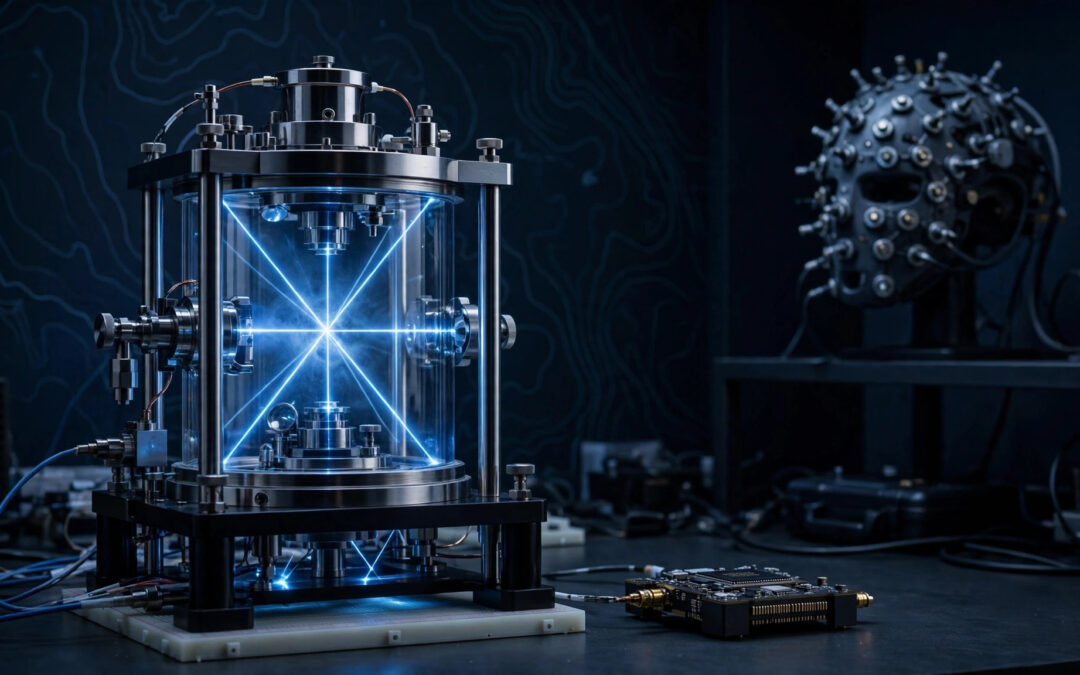
Ask when quantum technology will change the world and most people reach for the quantum computer — a machine that is always almost here, measured in roadmaps, milestones, and error rates that improve a little more each year. But there is a second branch of quantum technology that stopped waiting. It does not compute. It measures. And it is already installed on ships, flying in test aircraft, sitting in children’s hospitals, and watching a volcano.
Quantum’s first product won’t compute anything. It will measure something nobody could measure before. In several fields, it already does — because sensing gets to skip the hardest problem in quantum technology entirely.
Why sensing skips the hard part
A quantum computer has to keep thousands or millions of fragile quantum systems interacting, coherently, while errors are detected and corrected faster than they accumulate. That error-correction wall is why fault-tolerant machines remain a research program. A quantum sensor asks for something far simpler: one well-controlled quantum system, prepared carefully, allowed to interact with the thing you want to measure — a magnetic field, gravity, time itself — and then read out. The same sensitivity to the environment that makes quantum states so hard to compute with makes them exquisite detectors. Noise is the enemy of a quantum computer. To a quantum sensor, the signal is the noise.
That is why the maturity gap is so wide. Several classes of quantum sensor sit at the level engineers call field-deployed: products with datasheets, prices, and customers. Quantum computing, for all its genuine progress — including the result we covered when an AI proved an 18-year-old quantum conjecture in three days — is still producing papers. Sensing is producing purchase orders.
The clock that already runs your world
The original quantum sensor is the atomic clock, and it has been load-bearing infrastructure for decades: GPS satellites and telecom networks run on atomic time. The commercial frontier now is miniaturisation. Microchip’s chip-scale atomic clock — a quantum clock small enough to sit on a circuit board — has been a catalog product since 2011 and is deployed in military GPS receivers, drones, and secure communications, holding time precisely when satellite signals are jammed or absent. Britain’s Dstl has gone further, validating a cold-atom clock, AQlock, aboard Royal Navy vessels — timing that does not depend on anything outside the ship.
Time is the quietest of the sensing stories, but it may be the most strategic. Modern militaries, power grids, and financial networks all assume synchronised time delivered by GPS. A clock that keeps that time on its own is insurance against the day the signal goes away.
Navigation without GPS
That insurance logic is driving the most dramatic demonstrations in the field. GPS can be jammed cheaply and spoofed convincingly, so defence agencies are paying for navigation that reads the Earth itself. The planet’s crust has a magnetic signature — a fixed, unjammable map. In September 2026, the US Defense Innovation Unit announced that a quantum magnetic navigation system built by Honeywell Aerospace had guided a test aircraft for four hours and twenty-three minutes over the Pacific without GPS, improving position accuracy by 89 percent over traditional backup methods.
Weeks earlier, the Australian firm Q-CTRL ran the gravity version of the same trick. Its Ironstone Opal quantum gravimeter navigated a vessel through 83 kilometres of the Coral Sea without GPS, holding its position to within a nautical mile — more than ten times better than a navigation-grade inertial backup — while sitting in a passenger cabin, running autonomously, with no temperature control or stabilisation platform. A year earlier the same system had shown positioning accuracy 50 to 100 times better than conventional inertial navigation in flight trials. These are not laboratory curiosities anymore. They are flight-test results, published by the customers.
Gravity as a map, and a prospecting tool
A gravimeter sensitive enough to navigate by is also sensitive enough to see underground. Tiny variations in gravity reveal aquifers, mineral deposits, buried infrastructure, and the magma moving beneath a volcano. The French firm Exail’s Absolute Quantum Gravimeter has more than twenty units deployed worldwide; one has run continuously on Mount Etna since 2020, and three more were delivered in December 2025 to INVOLCAN, the Canary Islands volcanology institute, for monitoring in Tenerife. The same instrument class that steers a ship can watch a volcano breathe and tell a mining company where to drill. That range — defence, resources, civil safety — is what a real technology market looks like.
The clinic: hearing the brain think
The most human application belongs to magnetometers. The brain’s electrical activity generates magnetic fields billions of times weaker than the Earth’s, and the classic instruments that detect them — superconducting sensors in cryogenic helmets — are expensive, fixed, and one-size-fits-all. Optically pumped magnetometers from companies like QuSpin measure the same fields at room temperature, in sensors worn directly on the scalp. Wearable magnetoencephalography systems built on them have been sold commercially since 2021, including a 32-sensor installation at Toronto’s Hospital for Sick Children, where a child can sit, move, and be scanned by a helmet fitted to them. For epilepsy and developmental research, that is not an incremental improvement. It is a different kind of instrument.
Who’s buying — and the honest caveat
The buyer list explains the momentum: defence first (the US Defense Innovation Unit’s Project Farseer is a $200 million programme to field quantum sensing and timing hardware, structured to move prototypes into production contracts), then navigation, resources, and medicine. An industry survey by the QED-C consortium put quantum-sensing vendor revenue at roughly $470 million in 2025, projected to reach about $1.1 billion by 2028. Those are real numbers, and they are also small numbers — the same survey found more than a third of sensing vendors reported no sales at all in 2025. “Ships first” does not mean “ships at scale.” It means the technology crossed the line from promise to product while its famous sibling is still crossing from product to practical.
That ordering matters for how to think about the quantum era. The history of technology usually runs measurement before mastery: the thermometer before thermodynamics, the telescope before orbital mechanics. Quantum technology is following the same sequence. Before machines that compute with quantum states reshape what we can calculate, machines that measure with them are already reshaping what we can know — where we are without satellites, what lies beneath a volcano, what a child’s brain is doing in real time.
Explore the rest of the quantum landscape — computing, consciousness, and what the science actually says — at the Quantum Self hub.