
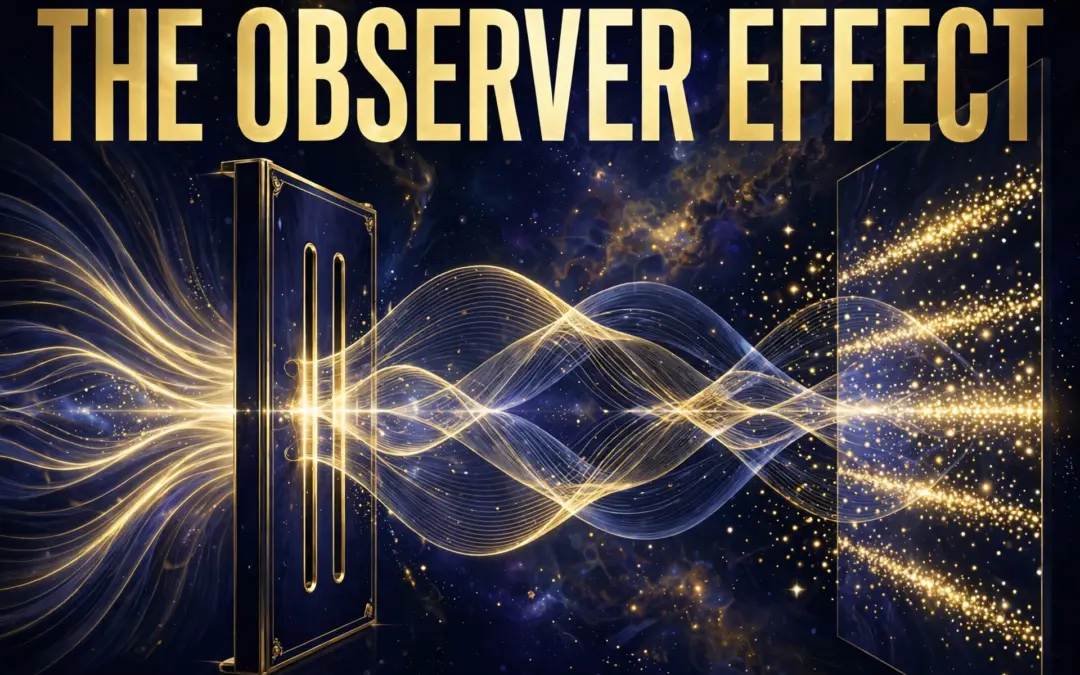
The Observer Effect Is Not a Slogan: What Measurement in Quantum Physics Actually Means
You have seen the claim, probably on a poster, a book cover, or a wellness feed: quantum physics proves your thoughts create reality. When you observe something, you collapse the wave function — so choose your observations wisely.
It is a great slogan. It is also, as a statement about physics, wrong in a specific and interesting way. The real observer effect is stranger than the poster version, and it needs no minds, no intentions, and no audience at all. What follows is what measurement in quantum physics actually means — and then, clearly labeled, what it legitimately suggests about the very different human business of attention.
The Experiment at the Center of It All
Everything starts with the double-slit experiment, the most famous demonstration in quantum mechanics. Fire electrons (or photons) at a barrier with two narrow slits, one particle at a time, and record where each one lands on a screen behind the barrier.
- With no detector at the slits: each particle lands as a single dot, but thousands of dots accumulate into interference bands — the signature of a wave passing through both slits at once and interfering with itself
- With a detector recording which slit each particle used: the interference bands vanish. The dots pile up in two plain clumps, exactly as if the particles had traveled like tiny bullets
Richard Feynman, who built a legendary lecture series around this setup, did not undersell it:
“[It is] a phenomenon which is impossible… to explain in any classical way, and which has in it the heart of quantum mechanics. In reality, it contains the only mystery.” — Richard Feynman, The Feynman Lectures on Physics, Vol. III
So far, the slogan sounds almost justified. Something about “watching” seems to change the outcome. The question is what “watching” means — and physics gives a precise, unglamorous answer.
What “Observation” Actually Means
In quantum mechanics, to observe a system is to interact with it in a way that extracts information. A measurement is a physical event, not a mental one:
- A detector is a machine. For a particle’s path to be known, something physical — a photon, an electric field, a sensor — must interact with it. That interaction is the measurement. No person needs to be present, awake, or even alive for it to happen.
- The record is what matters, not the reading. Labs run double-slit experiments automated and unattended, writing results to a disk overnight. The interference pattern is already fixed by whether which-path information exists in the world — not by whether anyone opens the file on Friday.
- Erasing the record can restore the wave. In quantum-eraser versions of the experiment, if the which-path information is destroyed so it can never be read by anyone, interference can reappear in the sorted data. What governs the outcome is the availability of information in the physical world — a fact about records and interactions, not about awareness.
The universe does not wait for an audience. It responds to interaction.
This is the point the slogan always skips: “observer” in physics is a role played by apparatus. A thermometer “observes” temperature by exchanging heat with what it measures. Nobody claims the thermometer’s consciousness sets the temperature.
Decoherence: The Explanation That Does the Heavy Lifting
If measurement requires no mind, why does the everyday world look so solidly classical? The workhorse answer is decoherence, developed from work by H. Dieter Zeh in 1970 and Wojciech Zurek in the 1980s.
A quantum system keeps its wave-like behavior only while it is effectively isolated. The moment it interacts with its environment — air molecules, stray photons, the warmth of the room — its quantum information leaks outward and entangles with countless environmental particles. The interference washes out, typically in times so short they make a blink look geological. Physicists call this environment-induced selection: the environment is, in effect, measuring everything constantly.
That is why electrons in a vacuum chamber can behave like waves and tennis balls cannot. It is not size alone or some rule about consciousness. It is that a tennis ball is being “measured” by its surroundings billions of times per second, and has been for its entire existence. Decoherence does not fully solve the deeper measurement problem — why one definite outcome happens rather than another remains genuinely debated — but it removes any need for a conscious observer in the mechanism. The universe was decohering things for billions of years before there were minds to notice.
Where the Consciousness Story Came From
The slogan has a real ancestor, and it is worth naming honestly. In the early decades of quantum theory, the mathematics described a chain of interactions — particle, detector, amplifier, notebook — without saying exactly where “measurement” finished. In the 1960s, the Nobel laureate Eugene Wigner speculated that the chain might end in consciousness itself. It was a serious philosopher-physicist’s speculation, never a consensus, and Wigner himself later stepped back from it as the decoherence research program developed.
Popular culture kept the speculation and dropped the caveats — including the caveat that its own author abandoned it. Meanwhile, physicists still disagree about the measurement problem’s final answer: Copenhagen-style, many-worlds, Bohmian and QBist interpretations tell different stories about what a measurement is. But notice what none of them changes: the double-slit results come out the same whether the lab is full of people or empty for a month. An unsolved problem is not a blank check, and “physicists disagree about the interpretation” is not evidence for “your thoughts collapse reality.”
Our learning-track companion page, The Observer Effect: Science vs. Metaphor, maps this same science-versus-metaphor boundary in outline; this article is the long version.
What It Legitimately Suggests About Attention — Labeled as Interpretation
Everything in this section is interpretation and psychology, not physics. We label it because the distinction is the whole point.
Here is the honest bridge. In human life, measurement really does change the measured — not through wave functions, but through feedback:
- Tracking changes behavior. People who log their spending spend differently; people who weigh themselves regularly manage weight differently. Behavioral scientists call this measurement reactivity, and it is one of the most reliable effects in applied psychology.
- Attention is a sampling instrument. You cannot perceive everything in a day, so your experienced reality is built from what your attention samples. Point it at threats and the day looks threatening; point it at evidence of progress and a different dataset — an equally real one — accumulates. That is selective perception, a well-documented feature of ordinary cognition. It needs no quantum garnish to matter.
- Even our AI tools run an observer loop. As we explored in AI Is Changing Human Consciousness Faster Than We Realize, algorithms now choose much of what we observe, and what we observe shapes what we do next. The “observer” bending outcomes there is an attention market, not a mind collapsing a wavefunction — and it is powerful enough without the metaphor.
The legitimate lesson quantum mechanics offers a human life is epistemic humility: at the bottom of things, reality is probabilistic, and some of what looks like solid fact is a summary of interactions. The practical lesson comes from psychology: measure carefully, because in a life — as in a lab — what gets measured is what becomes definite enough to act on.
The Bottom Line
The observer effect is not a slogan and not a permission slip for magical thinking. It is a precise claim: at the smallest scales, information-extracting interactions change outcomes, the environment performs those interactions constantly, and no consciousness is required anywhere in the machinery. The genuine article — superposition, decoherence, and an honestly unsolved measurement problem — is more interesting than the poster. It just asks something harder of us than belief. It asks us to keep the layers separate: physics where physics speaks, interpretation where we are the ones speaking, and wonder in both.